Context
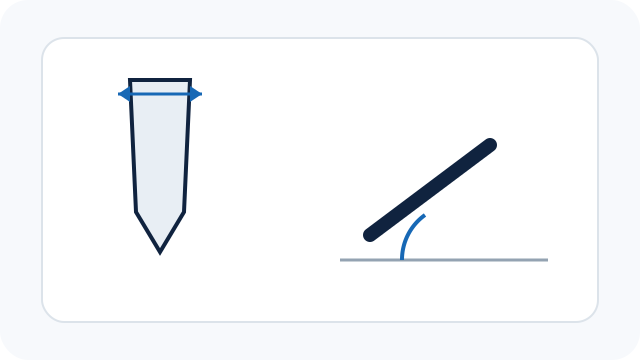
CalligraphyToolkit uses millimetres because a measured broad edge can be turned into physical x-height. Two values are often confused: nib width and nib angle.
Measure the writing edge
For a broad-edge nib, measure the flat edge that actually touches the paper. A ruler can be enough for clearly marked sizes; calipers are useful when the marking is absent or uncertain. Pilot lists Parallel Pen widths such as 1.5, 2.4, 3.0, 3.8, 4.5 and 6.0 mm, illustrating that the width is a physical property of the writing edge.
Nib angle is an orientation
Nib angle describes how the flat writing edge is rotated relative to the baseline. It usually is not a number printed on the nib. A 3 mm nib can be used at different angles for different hands or teaching models.
Letter slant is separate
The angle at which the letters lean is not the same as nib angle. Italic letters may lean while the nib edge is held at its own angle. Keep the two controls separate and start from a good reference alphabet rather than trying to make both numbers match.
Sources and further reading
These notes are based on the sources below. For deeper study, check the original source and a good reference alphabet or teacher.