Context
Most early problems are not a lack of talent. They come from mismatching tool, model, scale or practice method. The correction is usually concrete and testable.
Printing at the wrong scale
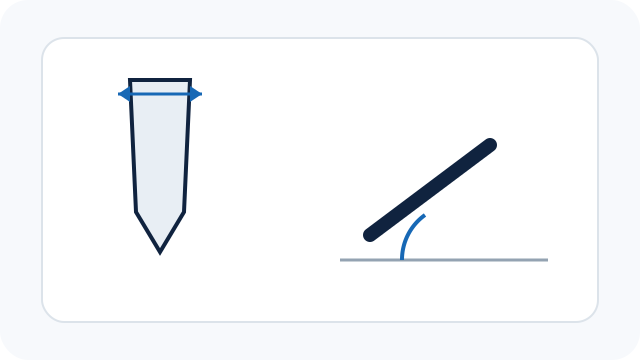
If a 3 mm nib is paired with a four-nib x-height, the body height must be 12 mm on paper. “Fit to page” destroys that relationship. Always check the 50 mm calibration bar before diagnosing your hand.
Using the wrong ink or tool model
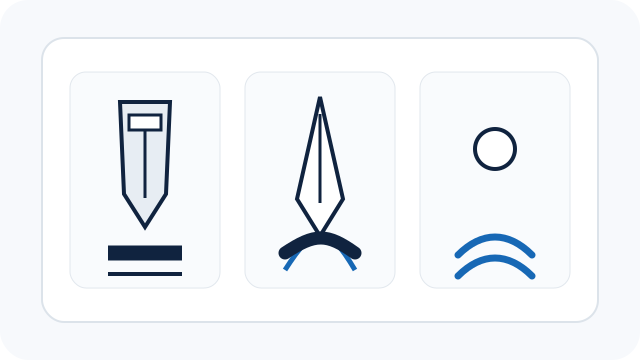
Do not assume every ink belongs in every pen. Pelikan, for example, explicitly marks one drawing ink as unsuitable for piston fountain pens. Likewise, a pointed flexible nib and a broad edge create contrast by different mechanisms, so they need different practice expectations.
Chasing angles before rhythm
Preset angles are starting points. A page of mechanically identical angle settings will not fix inconsistent spacing, irregular arches or poor pressure control. Work from a trustworthy exemplar, repeat small groups of related forms, and compare the white space as carefully as the black stroke.
Sources and further reading
- Maureen Peters — Calligraphy Workbook for Beginners (publisher page)
- Pilot — Parallel Pen
- Pelikan — Drawing Ink A 523
These notes are based on the sources below. For deeper study, check the original source and a good reference alphabet or teacher.